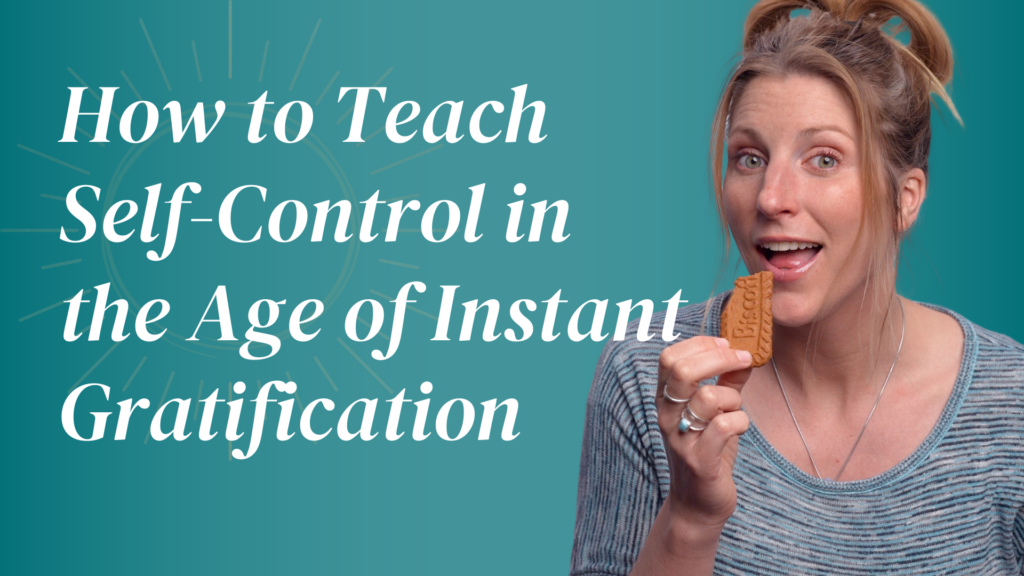
We live in a world where almost everything happens instantly.
Food arrives in minutes.
Shows start with one click.
And, answers appear the second we search for them.
And while this convenience can be wonderful, it also creates a challenge for kids. Because one of the most important life skills children need to develop is self-control.
The ability to wait.
The ability to pause before acting.
The ability to handle discomfort when something doesn’t happen right away.
But here’s the tricky part.
Children aren’t born with self-control. It’s a skill that grows through practice, modeling, and playful learning.
I’m Carly Schrimpl, Licensed Clinical Social Worker and owner of Power Within Child Therapists, where I help children and parents build the skills that support confidence, resilience, and healthy development.
And the good news about self-control is this: It doesn’t have to be taught through lectures or strict rules.
In fact, children often learn it best through games, curiosity, and everyday moments.
Here, I’ll share 4 ways to help strengthen self-control in your child.
#1: Teach Self-Control Through Play
A fun way to build self-control is through “eyes closed” games.
Here’s how it works:
Your child closes their eyes for a short period of time, maybe ten or fifteen seconds.
During that time, you try to distract them.
You might make silly noises.
Tap on the table.
Or, shuffle objects around the room.
Their job is to keep their eyes closed until the timer ends.
What’s happening here?
Your child is practicing holding a boundary with themselves. They’re learning to resist the urge to peek, even when something interesting is happening nearby.
And you can slowly increase the time as their skill grows.
#2: Use Distraction & Waiting Games
For example:
Place a small treat or toy on the table and set a timer. Your child’s challenge is to wait until the timer ends before touching it.
While they wait, you can invite them to talk, sing, or tell a story together. They’re learning that waiting doesn’t have to feel impossible.
Sometimes distraction can actually help the brain manage the urge to act right away.
#3: Try Mindfulness Activities with Food
Try this with a raisin, a berry, or a small piece of chocolate.
First, invite your child to look at the food.
What color is it?
What shape do they notice?
Then ask them to smell it. Next, place it on the tongue and wait a moment before chewing. Finally, take a bite and notice the taste.
This step-by-step experience helps children practice slowing down and paying attention, which strengthens the brain pathways involved in self-control.
#4: Model Self-Control
Another powerful teacher is you.
Children are constantly watching how adults handle waiting, frustration, and disappointment.
When they see you pause, think through a decision, or talk about managing a difficult moment, they begin learning that these skills are possible. You’re showing them that self-control isn’t about perfection.
It’s about practice and awareness.
And remember, self-control grows gradually. Just like learning to ride a bike or read a book, it takes time, repetition, and encouragement.
All of these playful moments and games are all helping your child’s brain develop the ability to pause and choose their next action. And that’s a skill that will support them for the rest of their life.
If you’d like more support helping your child build skills like self-control, patience, and emotional awareness, Power within would love to help!
When you’re ready, click the link below this video to schedule an appointment at Power Within Child Therapists.
Because when children develop the ability to pause and choose their actions, they become the master of themselves.