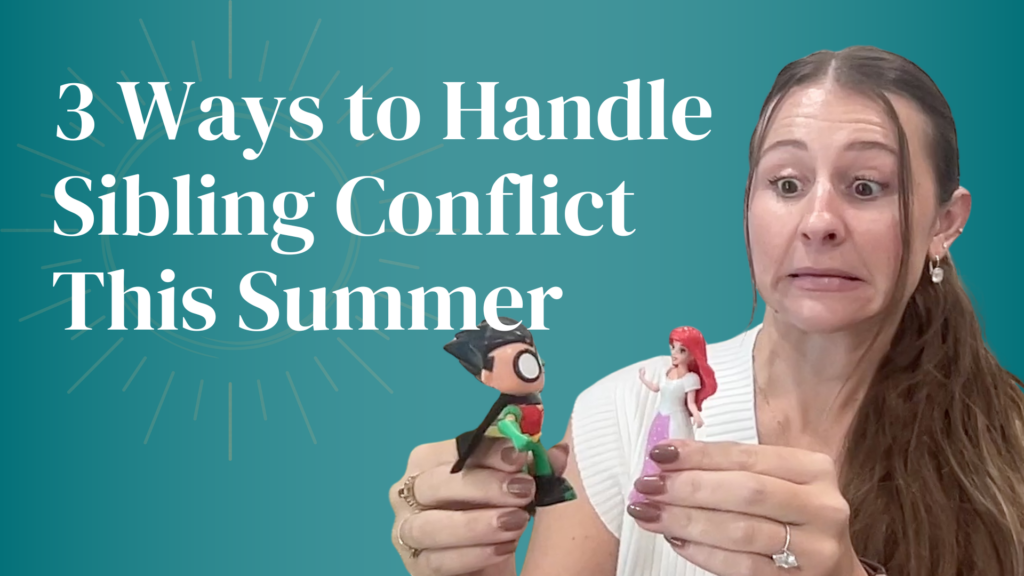
School’s out. The kids are home. And within 48 hours, they’re at each other’s throats. Sound familiar?
Sibling conflict during summer break is one of the most common things parents tell me they dread. There’s more time together, less structure, and more boredom.
It’s basically a recipe for constant fighting. And by August, everyone in the house is exhausted.
But here’s what I want you to know: sibling conflict isn’t a sign that something is wrong with your kids. It’s actually a normal part of growing up.
The goal isn’t to completely get rid of fighting. It’s to give your kids the tools to work through it, and to give yourself a playbook to help reduce fighting.
I’m Alex Hurst, a child therapist at Power Within Child Therapists. I work with children who are navigating challenges that affect how they feel about themselves and how they show up at home.
And sibling conflict is something almost every family I work with faces.
So now let’s talk about what actually helps with sibling rivalry.
#1: Give each child dedicated space and time that is truly their own.
A lot of summer sibling conflict comes down to one thing: too much time together with not enough breaks. It can be valuable for siblings to have time away from each other to do their own activities.
For older kids and teens, this might look like having a conversation before summer starts. Ask them, “What do you need this summer that’s just for you?”
It might be a corner of the house, a solo activity, or 30 minutes a day where no one bothers them.
For younger children, they can’t tell you what they need, but you can observe it.
Build in short periods of independent play every day, where each child has their own activity in their own area. Even 15 to 20 minutes makes a real difference for toddlers.
When each child has something that belongs to them alone: space, time, or a special toy, they come back to shared spaces with a lot less friction.
#2: Teach kids a simple repair process instead of jumping in to fix it.
When siblings fight, the instinct is to swoop in, figure out who started it, and hand down a verdict. But that actually keeps kids dependent on you to solve every conflict, and it doesn’t teach conflict resolution.
For school-age kids, try a three-step repair process.
Step one: pause and take a deep breath.
Step two: each person says how they felt, without blaming, using an I statement.
Step three: together, they come up with one way they can work together or take a break if needed.
It doesn’t have to be a long conversation. Even a quick, coached exchange builds the muscle over time.
For toddlers and young children, the repair process looks different, and that’s okay.
At this age, you’re not teaching negotiation, you’re modeling it. Get down to their level and name what you saw: “You grabbed the toy and she got upset. Let’s find another one for you.”
You’re planting seeds for empathy and problem-solving that will grow as they get older.
The point isn’t perfection. It’s that kids learn conflict is something they have the power to move through, not just something that happens to them.
#3: Look underneath the conflict for what's actually going on.
Sibling fighting is often a symptom, not the root problem. When kids are constantly at each other, I always ask: What else is going on?
Are they bored? Overstimulated? Feeling disconnected from a parent? Or anxious about something they haven’t named yet?
Big feelings that don’t have an appropriate outlet, unfortunately, often go toward the nearest sibling.
For older kids, you can start to ask gentle questions: “I noticed you and your brother are really butting heads lately. What’s going on for you?”
Sometimes just being asked is enough to open the door.
For toddlers and young children, they don’t yet have the language to tell you what’s wrong, so their feelings come out as behavior.
A toddler who is hitting or grabbing more than usual is often tired, hungry, overstimulated, or craving connection with you.
Before addressing the conflict itself, ask yourself, “When did they last eat, sleep, or have one-on-one time with me?”
Meeting those basic needs first can shift the whole dynamic.
This summer, pay attention to patterns. Does the fighting spike at certain times of day? Like after screens? Or when a nap gets skipped?
When you address the problem underneath, the conflict on the surface often drops significantly.
Sibling conflict doesn’t have to define your summer. When kids have their own space, learn how to repair, and feel seen and supported, things will start to feel lighter.
At Power Within Child Therapists, we work with kids to build confidence, emotional tools, and the skills they need to navigate relationships.
Schedule an appointment today, I’d love to work with your family.